If you run a local business — a dental practice, a roofing company, a restaurant, a law firm, anything that serves customers in a specific area — local SEO is the single most important marketing investment you can make. It's how you show up when someone in your city opens Google and types 'dentist near me' or 'best roofer in Tampa.'
The businesses that dominate local search aren't always the biggest or the best. They're the ones that understood how Google decides who to show first — and optimized for it. This guide will teach you exactly how that works, step by step, in plain English.
The Map Pack — the top 3 local results that appear before everything else on Google.
What Is Local SEO (And Why Is It Different)?
Regular SEO is about ranking your website for broad searches — 'how to fix a leaky faucet' or 'best CRM software.' Local SEO is about ranking for searches with local intent — 'plumber near me,' 'Italian restaurant downtown Tampa,' 'chiropractor Bonita Springs.' The difference matters because Google uses completely different signals to rank local results.
When someone searches for a local service, Google doesn't just look at websites. It looks at Google Business Profiles, reviews, directory listings, location data, and a dozen other signals to decide which three businesses earn a spot in the Map Pack. That's the box with the map and three listings that appears above all organic results. For most local businesses, getting into the Map Pack is more valuable than ranking #1 in organic search.
The numbers: 93% of online experiences start with a search engine. 46% of all Google searches have local intent. 76% of people who search for something nearby visit a business within 24 hours. If you're not showing up in local search, those customers are going to your competitors.
How Google Ranks Local Businesses
Google has told us exactly what factors determine local rankings. There are three, and you need to optimize for all of them.
Most local businesses lose on prominence. They have 5 Google reviews while their competitor has 80. Their business is listed inconsistently across the web. Their website hasn't been updated in two years. These are all fixable problems — and fixing them is what local SEO is all about.
Relevance, Distance, and Prominence — the three pillars of local search ranking.
Google Business Profile: The Foundation of Local SEO
Your Google Business Profile is the most important piece of your local SEO strategy. It's the listing that appears in the Map Pack, in Google Maps, and in the knowledge panel when someone searches your business name. If you do nothing else from this guide, optimize your GBP.
Claim and verify your listing
If you haven't already, go to business.google.com and claim your listing. Google will verify you own the business through a postcard, phone call, email, or video. This takes anywhere from a few days to two weeks. Without verification, you can't edit your profile or respond to reviews.
Complete every single field
This is where most businesses fail. They fill in the name, address, phone number, and hours — then stop. That's maybe 30% of what's available. Google rewards complete profiles because they provide a better experience for searchers.
The #1 mistake: Choosing the wrong primary category. Your primary category is the single strongest ranking signal in local SEO. 'Business consultant' is too broad — 'marketing consultant' or 'SEO agency' matches what people actually search. Research your competitors' categories and choose the most specific one that accurately describes your business.
Add photos — lots of them
Businesses with photos on their GBP receive 42% more requests for directions and 35% more clicks to their website. Google has said this directly. Yet most small businesses have zero photos or just a blurry logo.
Post regularly
Google Business Profile has a built-in posting feature that most businesses ignore completely. Posts show up on your profile and signal to Google that your business is active. Think of them like mini social media updates — promotions, news, events, tips. One post per week is a good rhythm. They expire after 7 days anyway, so consistency matters more than perfection.
A fully optimized GBP with photos, posts, reviews, and complete business information.
Reviews: The Ranking Factor You Control
Google reviews are the most visible and most impactful factor in local SEO. They directly influence your Map Pack ranking, they affect click-through rates (would you click a 3.2-star business or a 4.8-star business?), and they build the trust that turns searchers into customers.
How to get more reviews
The reason most businesses don't have reviews isn't that customers are unhappy — it's that nobody asked. People are willing to leave reviews for businesses they had a good experience with. They just need to be asked, and the process needs to be easy.
Review velocity matters: Google doesn't just look at your total review count — it looks at how consistently you're getting new ones. A business with 50 reviews that got 5 this month will often outrank a business with 100 reviews that hasn't gotten one in six months. Set up a system and keep it running.
Citations and NAP Consistency
A citation is any mention of your business name, address, and phone number (NAP) on another website. Think Yelp, Yellow Pages, BBB, Facebook, industry directories, your local chamber of commerce. Citations tell Google that your business is real, established, and part of the local ecosystem.
Why consistency is critical
If your business name is 'Smith Plumbing LLC' on your website, 'Smith Plumbing' on Yelp, and 'Smith's Plumbing LLC' on the BBB — Google sees three different businesses. Inconsistent NAP data confuses Google and dilutes your authority. Every listing, everywhere, needs to match exactly.
Where to build citations
Start with the big ones and work your way down. Each one adds a signal to Google that your business is legitimate and active.
Aim for 30-50 consistent citations as a baseline. Quality matters more than quantity — a BBB listing carries more weight than a random free directory.
On-Page SEO for Local Keywords
Your Google Business Profile gets you into the Map Pack. Your website gets you into organic search results. Both matter, and they reinforce each other. A strong website makes your GBP rank higher, and a strong GBP sends traffic to your website.
Target local keywords on every page
Every service page on your site should target a specific local keyword. Not just 'plumbing services' — but 'plumbing services in Tampa' or 'emergency plumber Tampa FL.' These are the searches with buying intent, and your pages need to explicitly match them.
Create location pages if you serve multiple areas
If you're a plumber who serves Tampa, St. Pete, and Clearwater, you should have a dedicated page for each city. Not duplicate content with the city name swapped — genuinely unique pages that reference neighborhoods, landmarks, and specific information about serving that area. Google can tell the difference between real location pages and lazy copies.
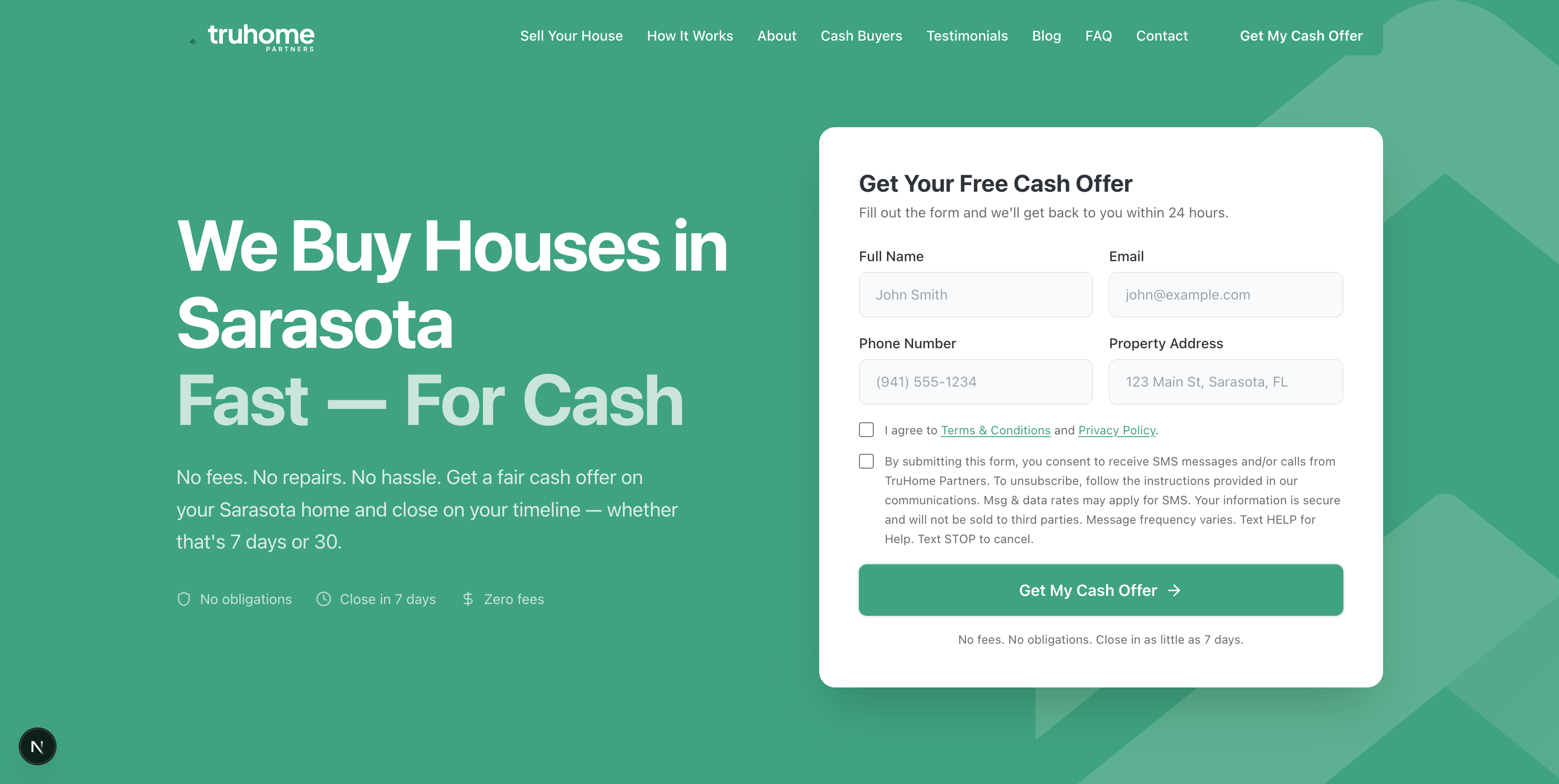
Location-specific landing page for TruHome Partners — Sarasota, FL.
Technical SEO: The Foundation Under Everything
Technical SEO isn't glamorous, but it's the foundation that makes everything else work. If your site is slow, broken, or hard for Google to read, none of the other stuff matters.
Site speed
Google has explicitly said site speed is a ranking factor. If your site takes more than 3 seconds to load, you're losing visitors and rankings. Most slow sites are bloated WordPress installations with 30 plugins, uncompressed images, and cheap hosting. A clean, custom-coded site on good hosting loads in under 2 seconds.
Mobile experience
Over 60% of local searches happen on phones. Google uses mobile-first indexing, meaning it ranks your site based on how it performs on a phone, not a desktop. If your mobile experience is clunky — tiny text, buttons too close together, horizontal scrolling — your rankings suffer regardless of how good your desktop site looks.
The technical checklist
Quick test: Open your website on your phone right now. Does it load in under 3 seconds? Can you read everything without zooming? Can you tap buttons without accidentally hitting the wrong one? Can you find the phone number and click to call? If any answer is no, you're losing customers every day.
How Long Does Local SEO Take?
This is the question everyone asks, and the honest answer is: it depends. But here's a realistic timeline for a small business starting from scratch.
DIY vs Hiring a Professional
Can you do local SEO yourself? Honestly, yes — some of it. Claiming your GBP, asking for reviews, and making sure your NAP is consistent are things any business owner can handle. But there's a point where it makes sense to hand it off.
The DIY approach works for the basics. But the technical work — site speed, schema markup, keyword strategy, content optimization, ongoing monitoring — that's where professional help pays for itself. The ROI math is simple: if local SEO brings you even two or three extra customers per month, it's paid for itself many times over.
The Bottom Line
Local SEO isn't magic and it isn't instant. It's a systematic process of telling Google exactly what your business does, where you do it, and why you're the best option. The businesses that win at local search are the ones that do the work consistently — optimizing their profile, earning reviews, building citations, and keeping their website fast and relevant.
You don't need to do everything in this guide at once. Start with your Google Business Profile. Get that fully optimized. Then build your review system. Then work on your website. Each piece reinforces the others, and the compound effect will put you ahead of competitors who are still running on an empty GBP and a website from 2018.
If you want help with any or all of this, that's literally what we do every day. We'll audit your current local SEO for free and show you exactly where the opportunities are. No commitment, no pitch — just a clear picture of where you stand and what it would take to rank.
Want Help With This?
We do all of this for small businesses every day. Tell us about your business and we'll schedule a free consultation — no commitment.